
The Unseen Inheritance: Why We Remember Our Ancestors
A couple of years ago, while meeting my relatives, we found ourselves reminiscing about childhood summers spent at our grandparents’ home. In a few such gatherings I had heard of how my maternal grandmother was always tired and devoid of energy, and how none of us ever saw her bustling around the house. Later it struck me: we truly do not know the trials she carried, the burdens she bore silently, or the nutritional and health challenges after birthing nine children that may have shaped her demeanor. Today, in an age of second-to-second biometrics, supplements, and data-driven automated living, it is easy to forget that our ancestors lived without these supports. They endured, adapted, and persevered in ways we will never fully understand. Remembering them is not nostalgia — it is humility.
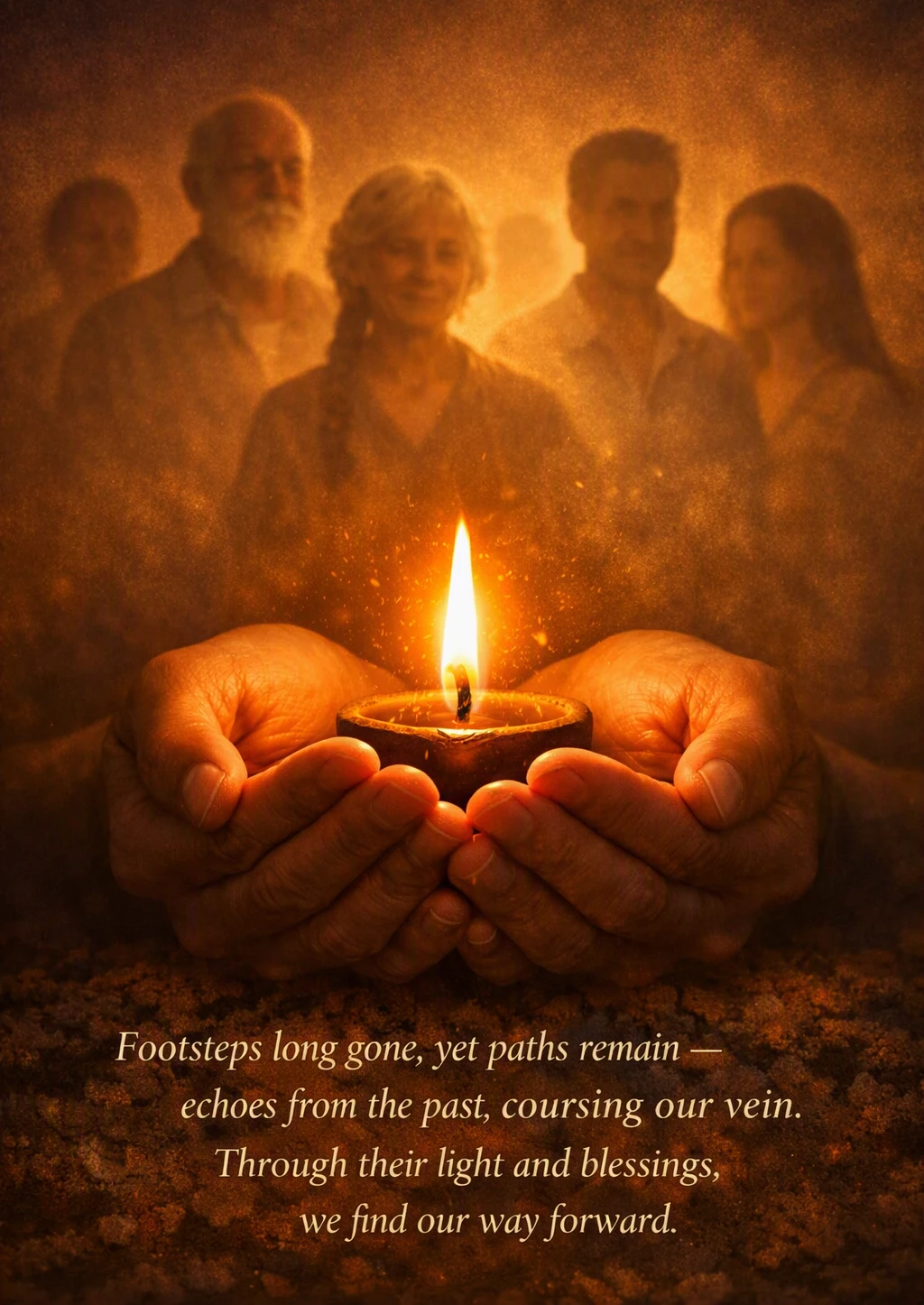
Across cultures, there is always a designated period for ancestral remembrance. In the Sanatana Dharma tradition, Pitru Paksha is that sacred window — and this year, it runs from September 27 to October 10, 2026. In this period, families pause to honor those whose lives made ours possible. Similar observances exist worldwide. Many indigenous traditions teach, “Honor your ancestors through your actions.” These rituals are not about mourning; they are about continuity. They remind us that we are part of a lineage — a thread of breath, earth, sky, and experience that stretches far beyond our individual lives.
Scriptures from many traditions teach that gratitude offered to ancestors generates puṇya, merit that brings peace for us now and across generations. Remembering our ancestors accomplishes something profound: it restores perspective, softens the heart, and anchors us in belonging. Gratitude is not merely a pleasant feeling — it is a form of healing. When we thank our ancestors, we acknowledge the invisible labor, sacrifices, and resilience that allowed us to stand where we stand today. In doing so, we complete the circle of lineage and carry their light forward.
So, taking the time to offer obeisance and gratitude to our ancestors is beneficial to us. Whenever an opportunity arises, gather your family, share why this matters, and engage in this remembrance practice which nourishes our body, mind, and soul.
“We are the like the apex of a pyramid – the levels of the pyramid ever widening toward its base represent past generations of our ancestors. Our present existence is the sum of all they did and we are the starting point for our descendants. All that our ancestors did reflect on us and all that we do reflects on both our ancestors and our descendants. Make a note of this.”